Embedding Automation Engineers Without a Six-Month Recruiting Cycle
Ops and product leaders often know exactly what automation work needs to happen. The bottleneck is scarce engineers and a recruiting cycle that outlasts the opportunity. Here is how embedding On-Demand Talent keeps ownership on your team—without a six-month wait.
JivePilot team · · 8 min read
There is a specific kind of buyer for On-Demand Talent: you already know the work.
You are not shopping for a vague “digital transformation.” You have systems, ticket queues, RMM or ops tooling, integrations that break, and a backlog of automations that would remove hours of manual work if someone senior enough actually owned the build. What you lack is capacity that matches your stack and working style—on a timeline that respects the business, not a recruiting calendar.
That is when “match in days, not months” is an operating requirement, not a slogan.
Why automation roles are a bad fit for slow hiring theater
Automation engineers sit at an awkward intersection: software craft, production systems judgment, and empathy for the operators who live with the scripts. Job posts attract either pure software generalists who underweight operational risk, or tool-click specialists who cannot design durable workflows.
Meanwhile the cost of waiting is not abstract:
- Manual processes keep burning staff time.
- Shadow scripts proliferate without review.
- Security and access hygiene drift because “temporary” workarounds stay forever.
- Roadmap items that depend on automation never quite start.
A six-month recruiting cycle for a role you already understand is often leadership choosing process comfort over delivery. Sometimes compliance or visa reality forces that timeline. Often it does not.
What “embedding” must mean
Embedding is not “a contractor in a shared Slack who disappears when Slack is quiet.”
For On-Demand Talent, embedding means:
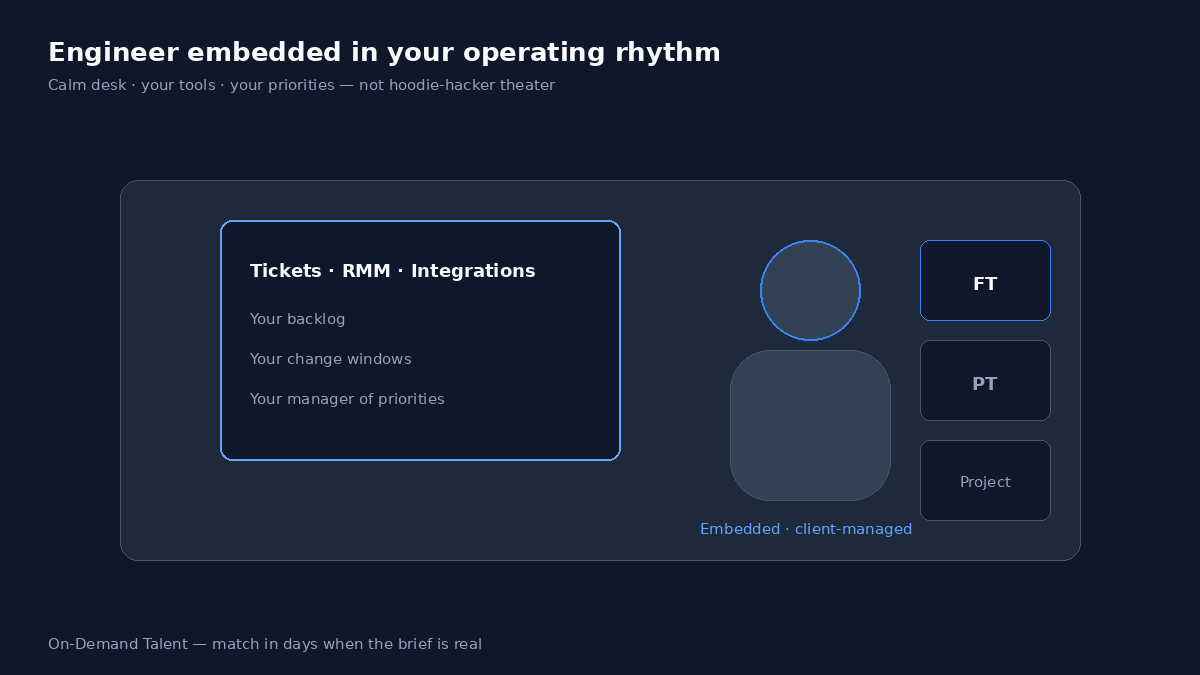
- Your priorities, day to day. You manage the work. The partner supports operating rhythm; they do not seize the roadmap.
- Your tools and rituals. Tickets, standups, on-call norms, documentation standards—adopted, not replaced with a parallel agency process.
- Match to stack, domain, and working style. An automation engineer who has lived near RMM, integrations, and operator workflows is not interchangeable with a greenfield app developer who likes greenfield demos.
- Engagement shape that fits reality: full-time, part-time, or project-shaped—written before start.
If a vendor only offers black-box project delivery when what you need is capacity inside your team, you are in the wrong engagement model. That is Managed Delivery territory—or a mix with a clear split. Do not blur them.
Amidaware-shaped proof (pattern language)
Locked proof pattern for On-Demand Talent: Amidaware—makers of Tactical RMM—where we placed two automation engineers full-time on their team.
What operators should take from that shape:
- The client had real product and ops context; they needed people on their team, not a slide about “AI transformation.”
- Full-time embedding was the engagement shape that matched how the work actually runs.
- Titles and stack specifics may refine under SME review; the ownership lesson is stable: scarce automation capacity, client-managed priorities, partner-matched people.
We do not invent additional logos, and we do not publish fake ROI percentages. Pattern language is enough for a leave-behind: if your situation rhymes, the model is relevant.
When you already know the work, the scarce resource is matched capacity—not another discovery workshop that rediscovers your backlog.
How to brief an automation embed in one page
A clear brief accelerates match quality more than a longer job description ever will.
Include:
- Systems map: what you run today (RMM, PSA, CRM, cloud, identity, custom glue)—even if imperfect.
- Top five automations that would change a week if shipped—written as operator outcomes, not ticket IDs alone.
- Constraints: security, access, change windows, who can approve production changes.
- Manager of priorities: named person on your side.
- Timezone and collaboration norms: East Coast / Israel overlap is common for our ICP—say what “local enough” means for meetings and incident response.
- Engagement shape: full-time vs. part-time vs. project-shaped, and expected duration range.
If you cannot name a manager of priorities, you are not ready to embed. You are ready to decide whether you actually need Managed Delivery for a bounded automation program instead.
Days, not months—what that requires from both sides
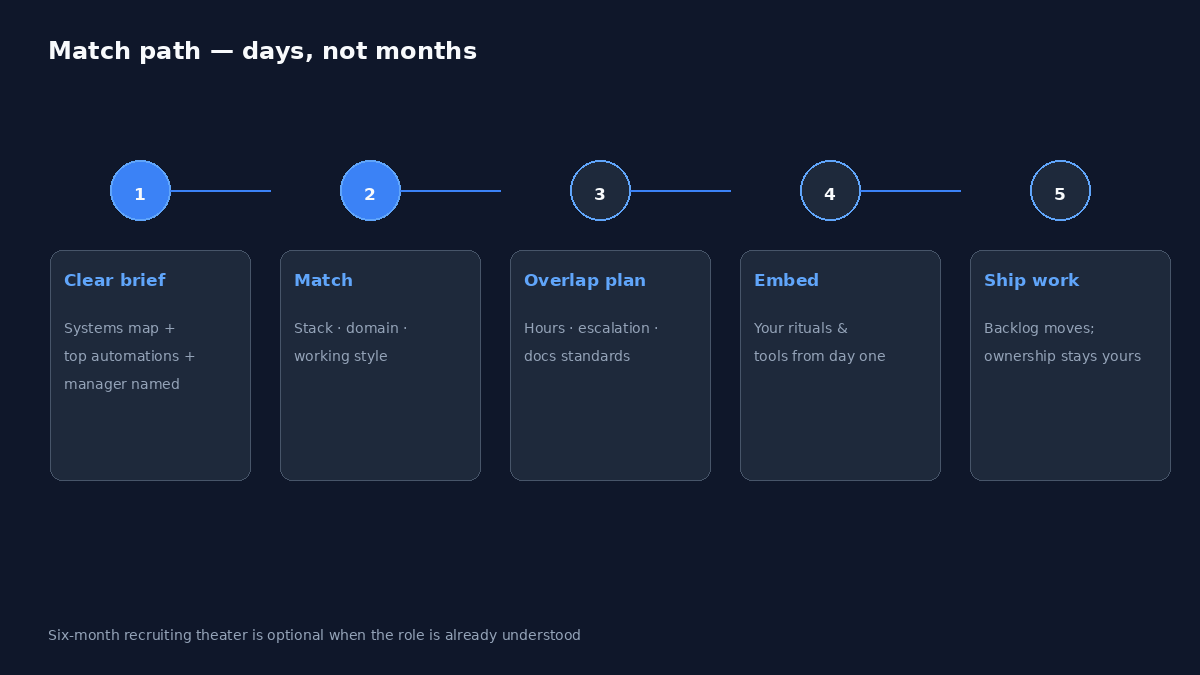
Partners can only match quickly when the brief is real. Clients can only absorb embeds quickly when onboarding is not theater.
From the partner side (what to demand):
- Senior conversation first—not a junior screener reading a script.
- Honest no-fit if the stack or seniority bar is wrong.
- Support for operating rhythm after start (check-ins that help retention and clarity), without hijacking priorities.
From your side (what to prepare):
- Access path that is secure and fast.
- A first two-week work package that is real production value, not busywork.
- A written definition of “done” for early automations so success is not vibes.
“Days, not months” fails when either side treats the first month as unpaid discovery disguised as employment.
Full-time, part-time, or project-shaped
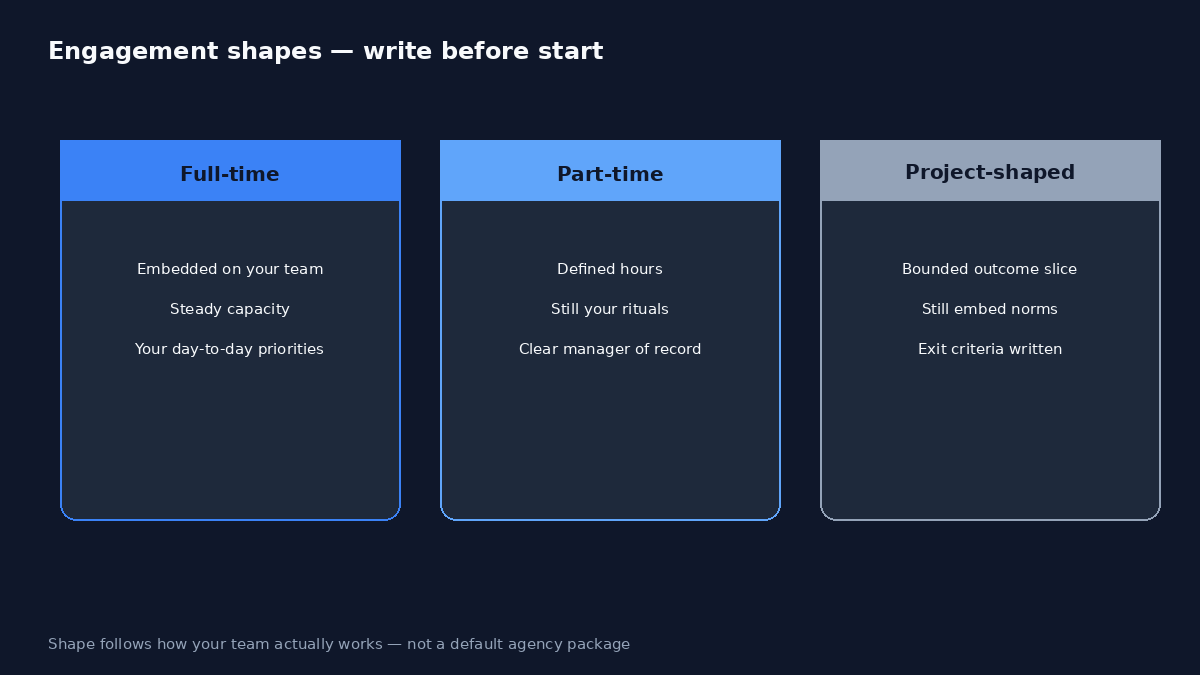
Automation work is not always a headcount-shaped problem.
- Full-time embed: ongoing backlog, production care, and continuous improvement inside your team.
- Part-time embed: steady but bounded capacity; useful when you have a strong internal lead and need senior horsepower without a full seat.
- Project-shaped: a defined automation program with an end state—still with your priority ownership if you choose On-Demand Talent, or partner-owned if you choose Managed Delivery. Write which.
Matching the shape to how your team works prevents the common failure of hiring a full-time seat for a three-month spike—or a three-month contractor for a forever backlog.
What not to buy
- Public rate cards that pretend every automation environment costs the same.
- Toptal-voice guarantees and leaderboard claims. Fit beats theater.
- A recruiting process that mirrors corporate HR when you already have a crisp brief and need capacity now.
- Product pitches disguised as talent. If someone pivots your automation need into an unrelated buy/try CTA, leave the meeting.
JivePilot’s On-Demand Talent path is professionals you manage day to day. Our Managed Delivery path is for when you want the outcome owned. AI systems we have built and operate (AwareCam, JiveAgents) are build proof elsewhere—not the CTA for this article.
A simple decision check
Ask your leadership team:
- Do we know the work well enough to manage an embedded engineer week to week?
- Is the bottleneck hiring latency and scarce fit—or unclear ownership of an outcome?
- Can we give access and a real first backlog immediately?
If yes / hiring latency / yes → On-Demand Talent.
If ownership of the outcome is the real gap → Managed Delivery (or a deliberate mix).
If you are unsure → say so on the path picker. That is a valid first call.
Next step
Tell us which path you need — Managed Delivery, On-Demand Talent, or not sure yet. For this topic, most readers preselect On-Demand Talent.
Book a call — path picker + one line on what you’re shipping → calendar.
Related
- Managed Delivery vs On-Demand Talent: How Ownership Should Be Written Before Kickoff
- Why Scaling Operators Replace Five Vendors With One Delivery Lead
- How to Evaluate an Execution Partner Without Theater or Soft Stereotypes
Engagement structure lives on How we work · Work