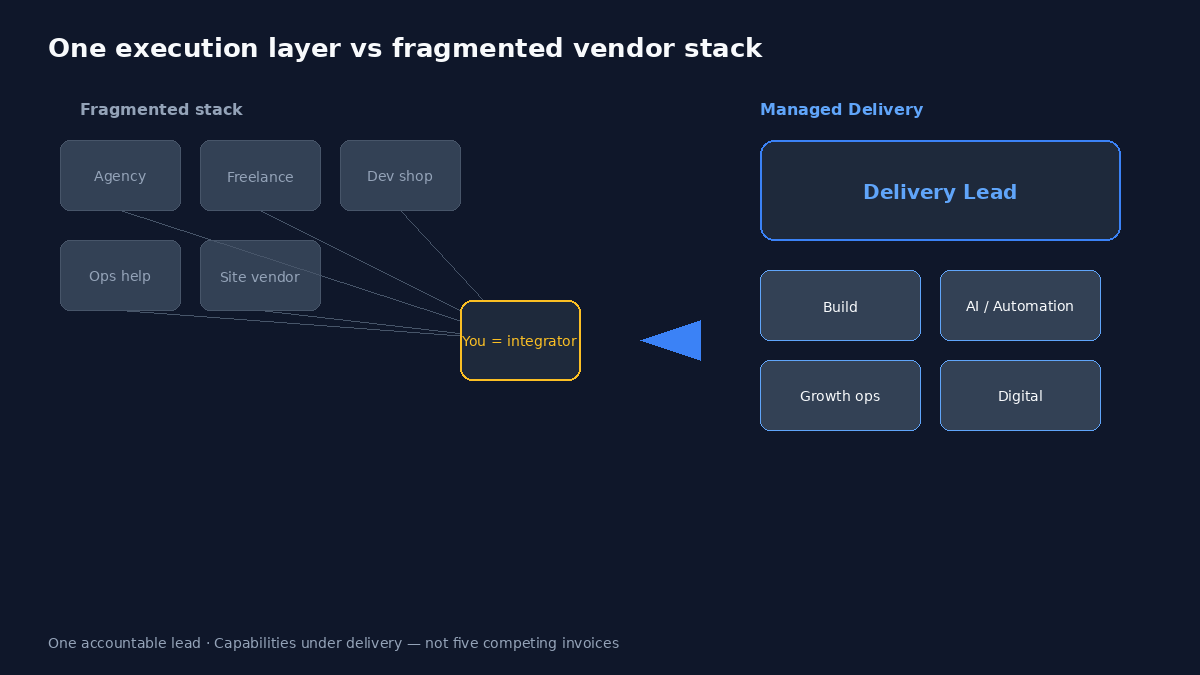
Why Scaling Operators Replace Five Vendors With One Delivery Lead
Scaling companies often accumulate freelancers, agencies, and specialists who each do fine work—and still miss the milestone. This piece explains why operators replace that stack with one delivery lead and a managed execution layer.
JivePilot team · · 9 min read
The pattern shows up the same way in New York, New Jersey, Florida, and Israel: a company that grew past founder-led hustle now has a marketing person here, a developer there, a freelancer for the site, an agency for campaigns, and someone “helping with ops automation” on evenings.
Each invoice looks reasonable. The calendar does not.
What breaks is not talent quality in isolation. What breaks is coordination ownership. Nobody owns the seams. Seams are where delays, rework, and “I thought you had that” live.
Managed Delivery exists for that moment: when the goal is the deliverable, and you want a delivery lead to staff and run the engagement so you get progress you can trust without assembling five vendors.
The real cost of five vendors is not the fifth invoice
Operators feel the tax in four places:
- Briefing debt. Every new person needs context. Context lives in Slack threads and founder memory. You pay for it every week.
- Sequencing fights. The site cannot wait for the CRM cleanup that cannot wait for the campaign that cannot wait for the analytics fix. Without a single plan owner, everyone optimizes their own ticket.
- Quality that does not compound. Good creative on a weak funnel, or strong engineering on an undefined operating rhythm, still underperforms.
- Accountability fog. When a launch slips, five partial owners produce five partial explanations. Leadership loses trust even when individuals worked hard.
That is why “just add one more specialist” often makes the system worse. You did not fix ownership. You added another seam.
What one delivery lead actually changes
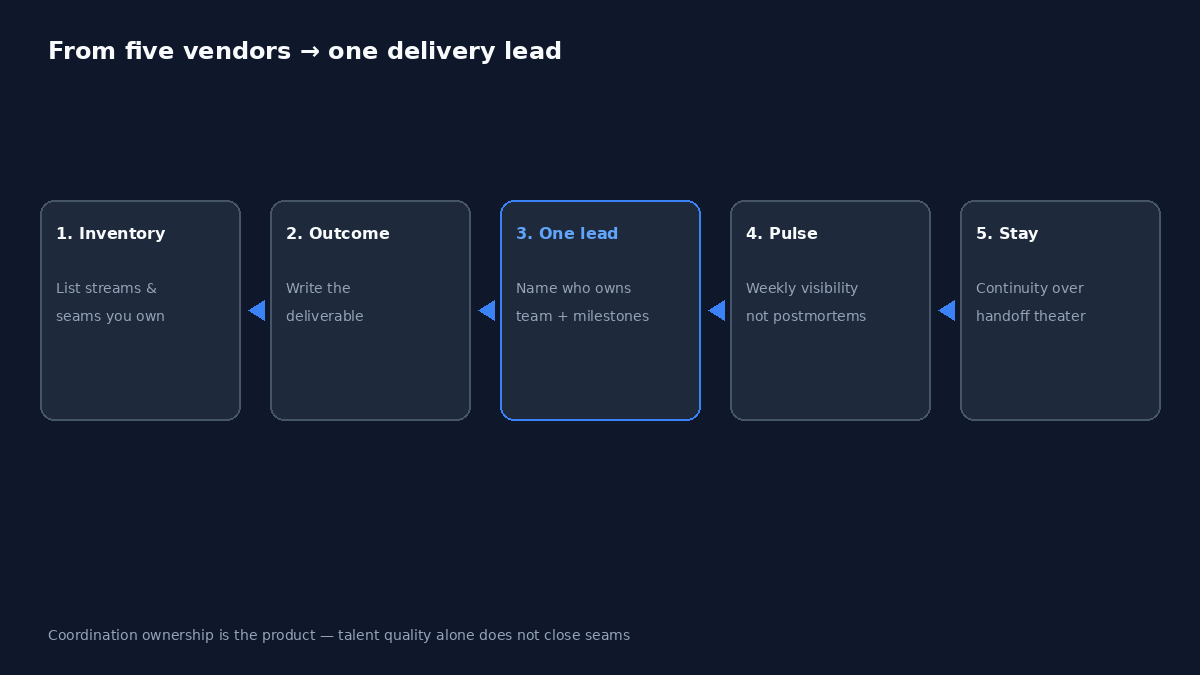
A delivery lead is not a project manager who forwards emails. In a Managed Delivery engagement, the lead is accountable for team, process, and milestones toward a written outcome.
Practically, that means:
- One execution layer instead of a vendor collage.
- Discovery that respects how your business runs—not a generic playbook dropped on your ops.
- Capabilities under delivery—software and product, AI and automation, marketing operations and growth engines, websites and digital platforms—staffed as needed under that lead, not sold as four separate products.
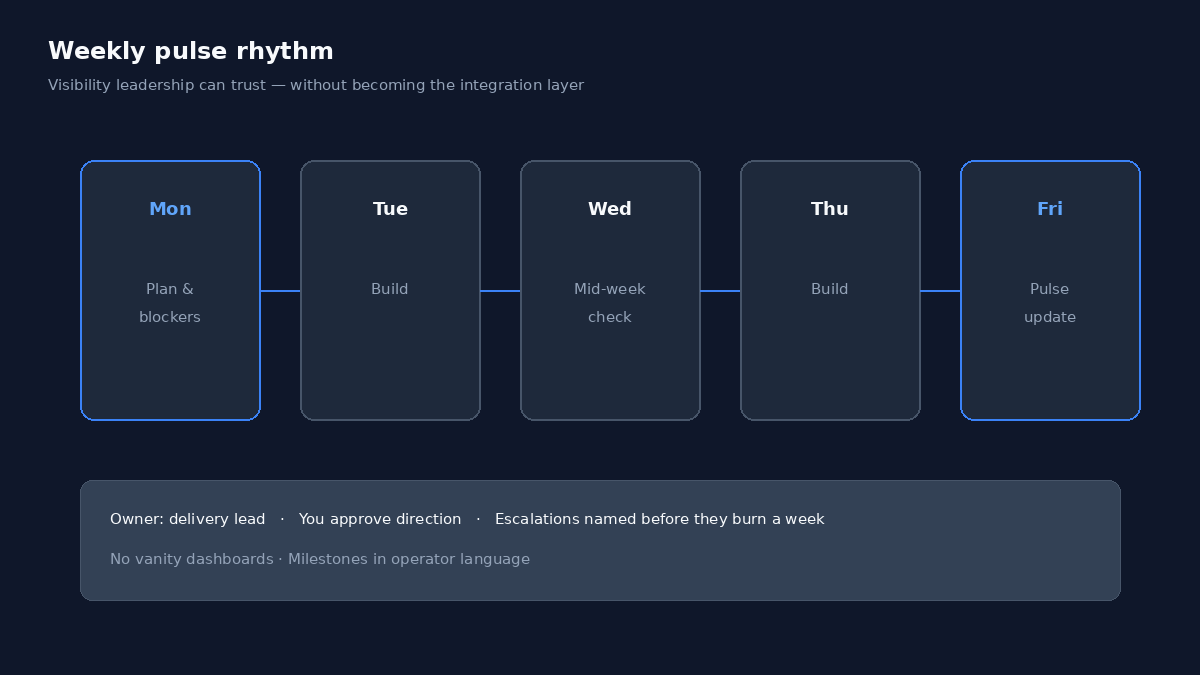
- Visibility + weekly pulse—so leadership sees blockers early, not postmortems late.
You still approve direction. You still care about brand, customers, and constraints. You stop being the only person who can stitch the work together.
Fragmentation is a leadership problem disguised as a hiring problem. One delivery lead does not magically create talent; it creates a place for talent to finish something.
A TalknSave / TCS–shaped example (pattern language)
We describe proof carefully. The locked pattern: ongoing marketing and technical execution for a telecom and travel operator (TalknSave / TCS Israel–shaped), multi-year Managed Delivery. Fragmented vendors were replaced with one structured delivery layer—and the engagement stayed active.
What that pattern teaches operators, regardless of industry:
- Multi-year beats handoff culture when the business keeps moving.
- Marketing ops and technical execution often need the same ownership layer, not two siloed retainers that never meet.
- “Still active” is a stronger signal than a splashy 90-day case study with no named durability.
We are not inventing new client logos here, and we are not publishing ROI percentages. The lesson is structural: when the operator needed continuity across marketing and technical work, one delivery layer outperformed a vendor pile.
When five vendors is still fine
Managed Delivery is not a moral judgment on freelancers or agencies. Keep a multi-vendor setup when:
- Each stream is truly independent (rare, but real).
- You have an internal owner with time and authority to integrate.
- The work is episodic, not an operating system for growth.
- You are deliberately buying a specialist craft boutique for a bounded creative or legal task.
The failure mode is using five vendors as a substitute for an internal operating layer you do not have. That is when a delivery lead is the cheaper honesty.
How to recognize you are past the collage stage
Signals we hear from East Coast and Israel operators:
- Founders or COOs are the integration layer by default.
- Campaigns, product releases, and site changes constantly block each other.
- You cannot point to one person (internal or partner) who owns “on time and coherent.”
- Vendors are competent in meetings and somehow late in combination.
- You have tried “one more coordinator” and still lack outcome ownership.
If three or more sound familiar, you are not under-staffed on specialists. You are under-owned on delivery.
What good kickoff writing looks like
Before you replace the collage, write:
- The outcome in operator language (what ships, for whom, by when—ranges OK if honest).
- In-scope capabilities under the delivery lead (and what stays intentionally out).
- Decision rights—what the lead can decide vs. what needs your approval.
- Rhythm—weekly pulse, escalation, and how async updates work across timezones (East Coast ↔ Israel is a common constraint; name it).
- Relationship shape—project-shaped vs. years-shaped. Handoffs are expensive; say if you want continuity.
If a partner cannot discuss those without jumping to a public package price, they are selling units of time, not delivery.
Anti-patterns to refuse politely
- A sixth vendor who “will manage the other five.” That usually adds a forwarding address, not ownership.
- Four equal lanes sold as AI / Build / Grow / Talent theater. Capability lists under one delivery model are fine. Parallel brand lanes that compete for budget are not.
- Unnamed <90-day hero stories as proof. Durability matters more than novelty.
- Product checkout CTAs from an execution partner’s insights. When we mention systems we have built (AwareCam, JiveAgents), that is expertise proof for delivery—not a buy button for a camera product.
Moving from collage to one lead—without a big-bang cutover
Serious operators rarely fire everyone on Friday. A sane path:
- Name the outcome stream that hurts most (often growth engine + platform, or ops automation + customer-facing systems).
- Put that stream under Managed Delivery with a delivery lead.
- Hold or wind down vendors whose work sits inside that stream; keep specialists whose work is truly outside it.
- Measure seams, not vibes: fewer re-briefs, clearer milestone ownership, fewer “who owns this?” threads.
- Extend only when the first stream is boringly reliable.
Boringly reliable is the point. Fortune-feel professional services is calm delivery, not drama.
Who this is for
Scaling companies and institutions that need owned delivery—including operators serving Jewish communities across the US East Coast and Israel—when the constraint is execution coherence, not another pitch deck. Global professional standard; one accountable lead where the seams used to be.
If you already know you need people embedded under your management instead, that is On-Demand Talent—a different ownership model, same partner. Do not force Managed Delivery language onto a capacity problem, and do not force talent language onto an ownership problem.
Next step
Tell us which path you need — Managed Delivery, On-Demand Talent, or not sure yet. For this topic, most readers preselect Managed Delivery.
Book a call — path picker + one line on what you’re shipping → calendar.
Related
- Managed Delivery vs On-Demand Talent: How Ownership Should Be Written Before Kickoff
- Embedding Automation Engineers Without a Six-Month Recruiting Cycle
- How to Evaluate an Execution Partner Without Theater or Soft Stereotypes
Engagement structure lives on How we work · Work