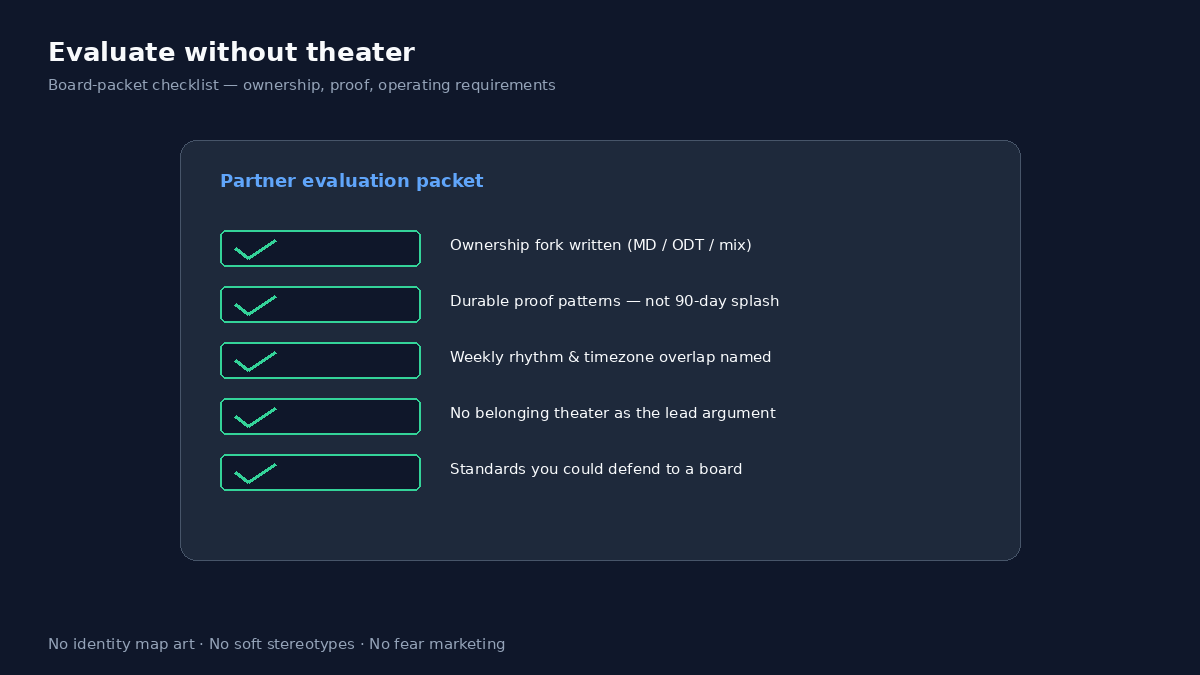
How to Evaluate an Execution Partner Without Theater or Soft Stereotypes
“We understand your market” is easy to claim and hard to prove. Here is how to evaluate an execution partner on ownership, delivery, and operating requirements—without buying pitch theater or soft stereotypes.
JivePilot team · · 9 min read
Serious operators do not need another vibe check. They need a filter that survives a board packet.
Pitch decks often lead with belonging language: cultural fluency, community feel, “we get how you work.” Sometimes that is sincere. Often it is theater—soft stereotypes dressed as insight, fear marketing dressed as urgency, or friendly tone with no delivery discipline underneath. The job of this article is to replace that with questions you can actually ask.
Use local trust and global standard as operating requirements you can check—timezone design, stakeholder fluency, ownership clarity, milestones you could defend—not as slogans.
Local trust is how decisions get made in your world. Global standard is how work gets finished without drama. An execution partner should be fluent in both—or honest when they are not.
Start with ownership, not identity
Before anyone talks stack or headcount, force a clear answer:
- Managed Delivery — a delivery lead owns team, process, and milestones; you buy an outcome.
- On-Demand Talent — vetted people embed on your team; you manage day-to-day priorities.
- A written mix — which stream is managed, which is embedded, named in the brief.
If a partner cannot explain that fork without sliding into a four-lane services menu, you are still shopping theater. Same partner is fine. Fuzzy ownership is not.
What local trust means in operations (not identity talk)
Local trust is not ethnicity cosplay. It is whether stakeholders believe you will handle their context with care.
In practice, operators mean things like:
- Calendar and rhythm reality. Named overlap hours across regions—not wished away with “we’re async.”
- Stakeholder fluency. Boards, community institutions, family-owned groups, and professional management teams often sit in the same decision. A partner who only knows SaaS startup rituals will miss how approvals actually happen.
- Language and register. Commercial English with the languages your operating team actually needs—not decorative translation, and not English-only arrogance when another locale matters.
- Reputation density. In tighter networks, delivery quality travels by referral faster than any ad. Trust is an asset you can lose once.
None of that requires stereotyping customers. It requires adult awareness of how dense professional environments run.
For JivePilot, who we serve includes scaling companies and institutions that need reliable capacity or owned delivery—including operators serving Jewish communities across the US East Coast and Israel. That context belongs in ICP honesty. It does not belong as the hook of the evaluation—and it never excuses lower standards.
What global standard must mean
Global standard is the opposite of “casual because we’re friendly.”
It means:
- Senior-led conversations. Founder-level clarity at the start—not a junior funnel that only becomes serious after three discovery workshops.
- Visibility and milestones that would not embarrass you in front of a demanding board.
- No fake Fortune logos, rankings, or headcount. Calm professional services tone—structure inspired by serious talent marketplaces, never “Top 3%” voice or trial-guarantee theater.
- Proof that holds up over time. Multi-year Managed Delivery patterns (TalknSave / TCS Israel–shaped) and embedded talent patterns (Amidaware-shaped) beat unnamed <90-day hero stories.
Friendly without standards becomes unreliable. Standards without trust become brittle. Most serious buyers need both.
Why senior-led delivery beats “we understand your market”
“We understand your market” is a claim. Senior-led delivery is a behavior.
On a first call, you should hear which path fits, who owns what, how the week runs across timezones, and what proof is allowed—durable patterns, not splashy short pilots or product cross-sells on an insights leave-behind.
If the partner leads with belonging language and never reaches ownership design, you are still in theater.
How trust + standard show up in delivery choices
Timezone and collaboration are not soft preferences. They are delivery constraints.
For Managed Delivery:
A delivery lead must design the weekly pulse so stakeholders across regions can attend or catch up asynchronously without losing the plot. “We’ll Slack you” is not a rhythm. Written updates, clear owners, and decision windows that respect both sides are.
For On-Demand Talent:
An embedded engineer or operator who never overlaps with your managers is not embedded; they are distance without a plan. Overlap hours, escalation paths, and documentation standards should be explicit in the brief.
For mixed engagements:
Write which stream is managed and which is embedded. Do not let “we’re flexible” become two timezones of ambiguity.
What to refuse on purpose
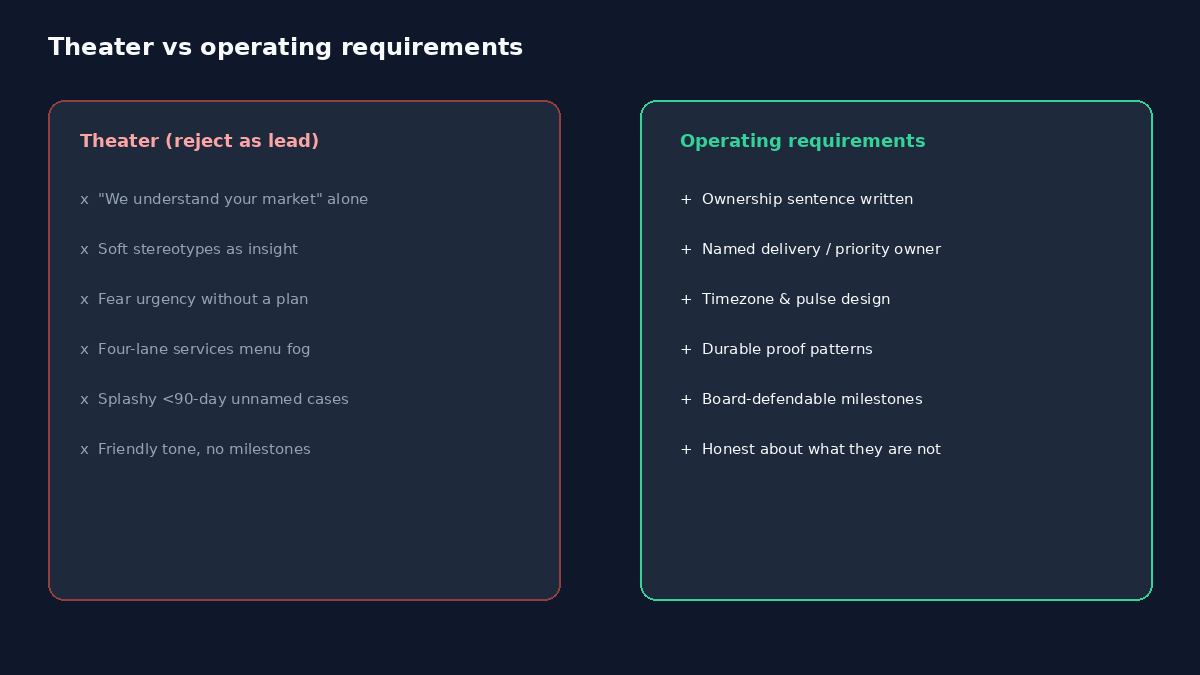
Marketing failure modes around “local trust” are predictable. Hold partners—and yourself—to refusing them:
- No soft bigotry. No “your community is unique so standards don’t apply,” and no “we only hire from X” as a substitute for competence.
- No fearmongering. Continuity, discretion, and security matter for many institutions and businesses. They are scoped in discovery—not sold with panic copy.
- No religious or political content marketing dressed up as Insights. This is an execution partner leave-behind, not a communal soapbox.
- No inventing proximity. If a capability or office claim is not real, it does not appear. Trust dies on exaggerated localness.
The correct posture is the same posture serious firms use in any dense professional network: respect context, deliver to a high bar, keep claims modest and true.
The evaluation checklist (board-packet ready)
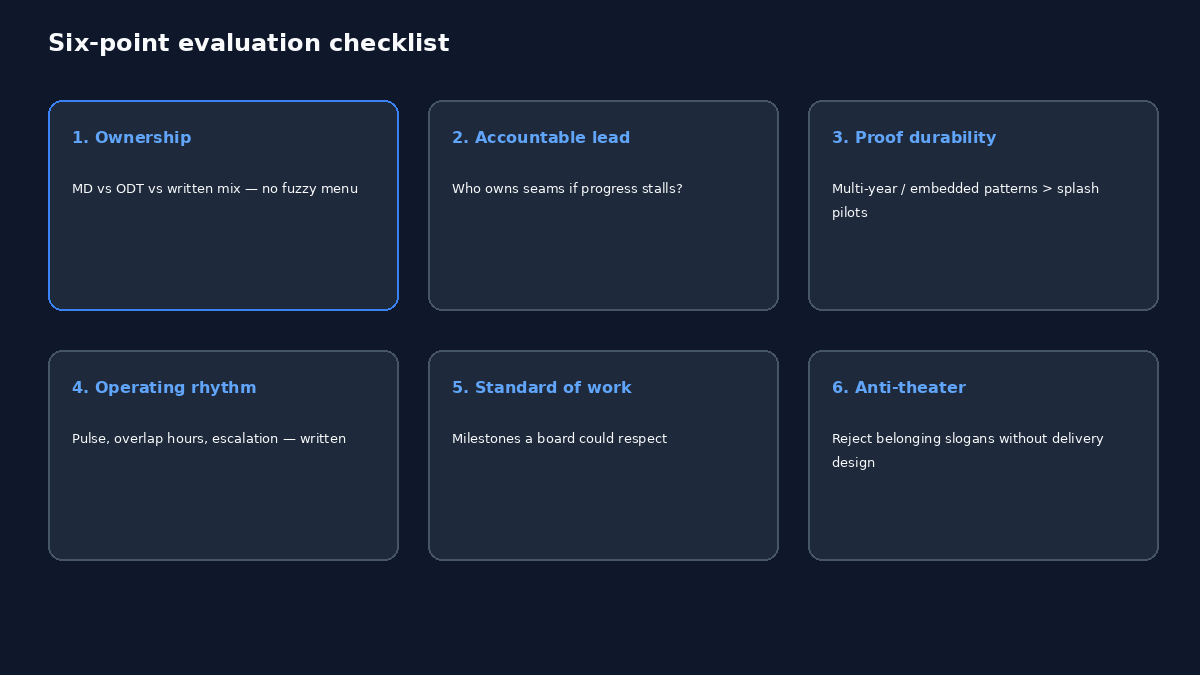
- Ownership model clarity. Can they explain Managed Delivery vs. On-Demand Talent without a services maze?
- Proof durability. Multi-year or clearly embedded work—or only splashy short pilots?
- ICP honesty. Do they name operating context once and move to delivery—or treat audience labels as the whole pitch?
- Funnel integrity. Book a call with a path picker and a one-line brief—or WhatsApp scripts and product checkouts?
- Build proof vs. product push. If they have built AI systems (AwareCam, JiveAgents), is that delivery expertise—or a buy/try distraction on an insights page?
- Leave-behind cleanliness. No objection-coaching banners, no public rate cards, no stacked “we’ll estimate after…” filler.
If a partner needs to lean on identity more than on ownership and delivery, keep looking.
What to bring to the first conversation
You do not need a deck. You need:
- The outcome or capacity need in one paragraph.
- Whether ownership should sit with a delivery lead, with your managers, or a written mix.
- Constraints that are truly local: timezone overlap, language needs, stakeholder map, compliance, and what “discreet” means operationally.
- Whether you want a years-shaped relationship vs. a one-shot project. Handoffs are expensive in dense networks.
How this connects to the two offers (without forcing one)
Managed Delivery often fits operators done coordinating fragmented vendors who need one execution layer with a delivery lead.
On-Demand Talent often fits operators with a strong internal team who need scarce people embedded quickly—matched to stack and working style.
Not sure is common when stakeholders disagree on ownership across sites or timezones. Settle that on a short founder call before the SOW.
Closing standard
Evaluating without theater means holding a simple bar:
- Trust without standard → nice people, late work.
- Standard without trust → polished decks, poor fit.
- Both → an execution partner you can keep for years.
That is the filter we recommend—and the bar we write toward ourselves.
Next step
Tell us which path you need — Managed Delivery, On-Demand Talent, or not sure yet.
Book a call — path picker + one line on what you’re shipping → calendar.
Related
- Managed Delivery vs On-Demand Talent: How Ownership Should Be Written Before Kickoff
- Why Scaling Operators Replace Five Vendors With One Delivery Lead
- Embedding Automation Engineers Without a Six-Month Recruiting Cycle
Engagement structure lives on How we work · Work