Managed Delivery vs On-Demand Talent: How Ownership Should Be Written Before Kickoff
Most delivery friction is not a talent shortage. It is unclear ownership. This piece lays out how operators should choose—and write down—Managed Delivery versus On-Demand Talent before the first sprint starts.
JivePilot team · · 8 min read
Most engagements that “feel messy by week four” were messy on day zero. The people were fine. The tools were fine. What was missing was a plain sentence about who owns the work.
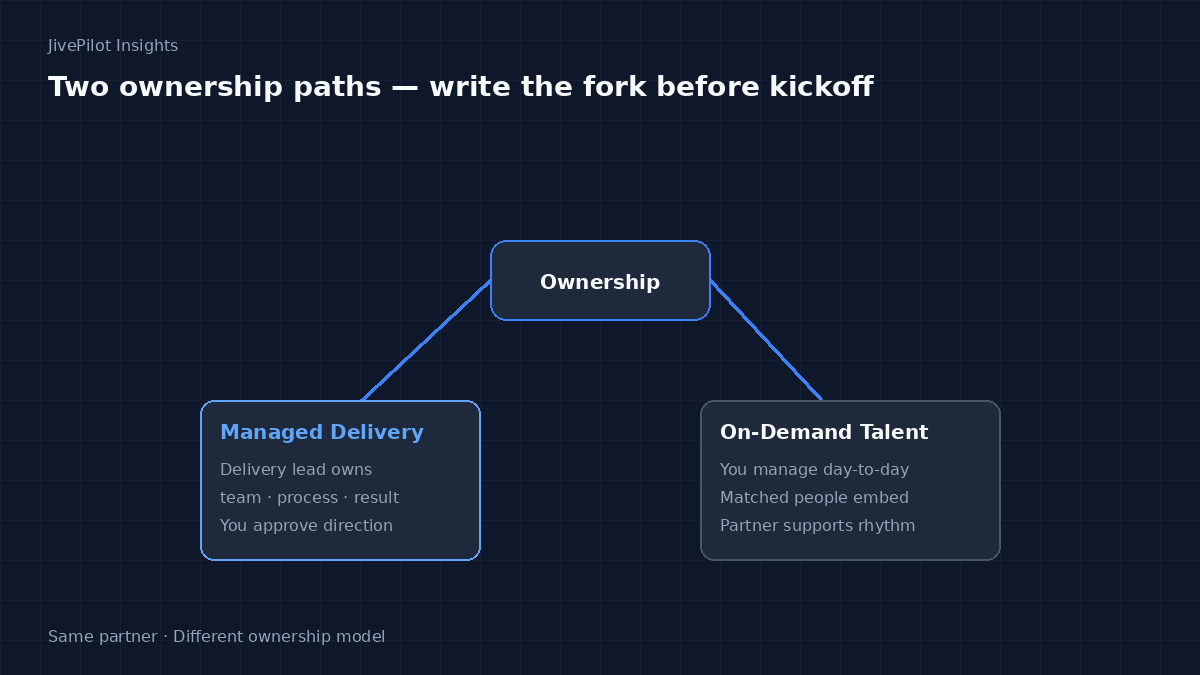
JivePilot runs two engagement models on purpose: Managed Delivery when you want a built outcome under a delivery lead, and On-Demand Talent when you want vetted people on your team and you keep day-to-day control. Same partner. Different ownership. Choosing once—or combining deliberately—beats discovering the gap mid-project.
This is a leave-behind for operators who are about to buy capacity or buy an outcome. It is not a rate card, and it is not a sales script. It is the conversation we recommend having before kickoff.
The question that should come before resumes
Ask this first: Who is accountable for the result if progress stalls?
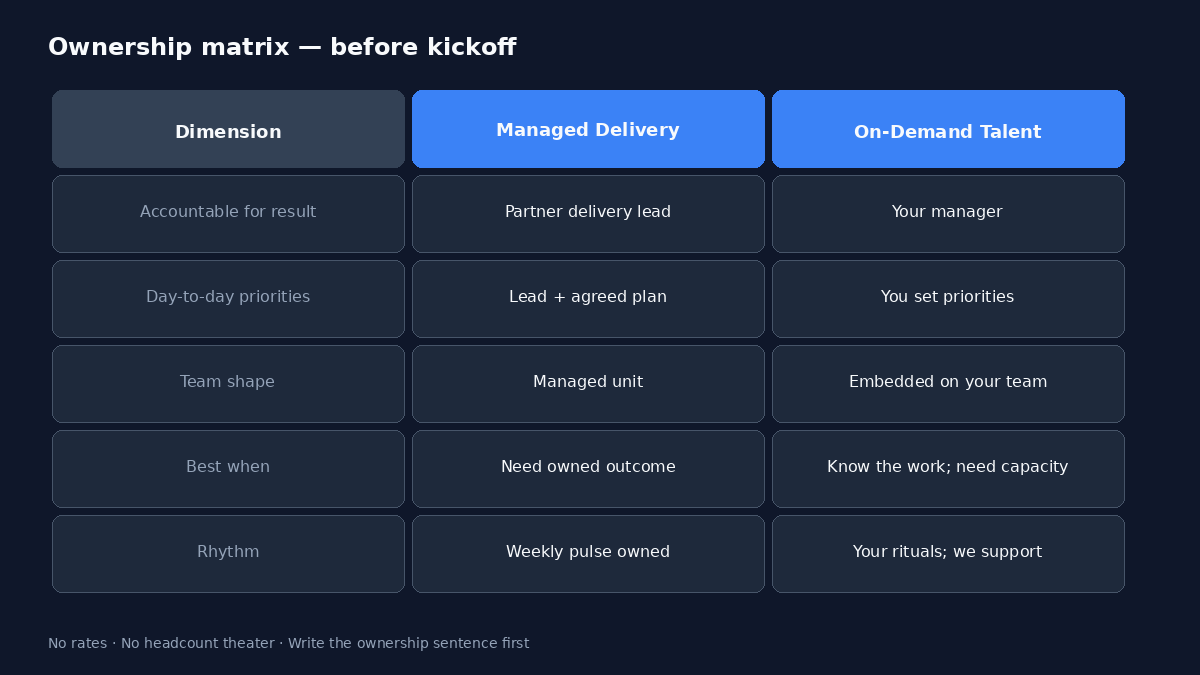
If the answer is “we are—we just need more hands,” you are in On-Demand Talent territory. You know the work. You have a manager (or you are the manager). You need people who match stack, domain, and working style, embedded so priorities stay yours.
If the answer is “we need the project owned end to end—team, process, milestones,” you are in Managed Delivery territory. You still stay close. You still approve direction. But someone on the partner side is measured on delivery, not on hours filled.
If you cannot answer, do not force a model. Book a short call, say you are not sure yet, and write the ownership sentence together. Path confusion at the start is cheaper than path confusion at month two.
Managed Delivery: ownership of the outcome
Managed Delivery is for when the goal is the deliverable. A delivery lead staffs and runs the engagement. You get progress you can trust without assembling five vendors and hoping they coordinate.
Under that lead, the work can span software and product build, AI systems and automation, marketing operations and growth engines, or websites and digital platforms. Those are capabilities under delivery—not separate brands competing for your attention.
What you should expect written before kickoff:
- Outcome and milestones in language your operators recognize—not vanity dashboards.
- Who decides what (you vs. delivery lead) on scope, sequencing, and “good enough to ship.”
- Visibility rhythm—weekly pulse, blockers, and what “on track” means in your calendar, not ours.
- Team shape as a managed unit—not a revolving door of freelancers you have to re-brief every Monday.
Proof pattern, not a pitch deck inventing logos: multi-year managed marketing and technical execution for a telecom and travel operator (TalknSave / TCS Israel–shaped) replaced fragmented vendors with one structured delivery layer and stayed active. That is the shape of the problem Managed Delivery solves—fragmentation and ownership drift—not a claim that every company looks the same.
On-Demand Talent: ownership stays with you
On-Demand Talent is for when you already know the work and need capacity. You get professionals matched to your stack, domain, and working style. They embed on your team. You set priorities day to day. We support operating rhythm; we do not take the product or ops roadmap away from you.
What you should expect written before kickoff:
- Role definition that a hiring manager would recognize—not a vague “full-stack ninja.”
- Engagement shape: full-time, part-time, or project-shaped—matched to how your team actually works.
- Manager of record for priorities—named person on your side.
- Match timeline measured in days when the brief is clear, not a six-month recruiting theater for a role you already understand.
Proof pattern: placing automation engineers full-time on an operator’s team (Amidaware-shaped—makers of Tactical RMM) is the On-Demand Talent shape. Scarce technical capacity, clear work, ownership stays with the client. Titles and exact stack details stay with SME review; the ownership lesson does not.
Same partner, different contracts with reality
Operators sometimes ask for “a hybrid” without defining the split. Hybrids work. Vague hybrids fail.
A clean mix looks like: Managed Delivery owns a bounded workstream (for example, a platform rebuild or a marketing ops engine) while On-Demand Talent embeds one or two specialists into your existing product squad. Two ownership sentences. Two success definitions. One relationship.
A messy mix looks like: “Can you just put people on our Slack and also own the milestone chart?” That sentence should not leave the room until it is rewritten.
Write ownership before kickoff: who manages the people day to day, who owns the process, and who is accountable for the result. Everything else is staffing detail.
How to write the ownership sentence (a short template)
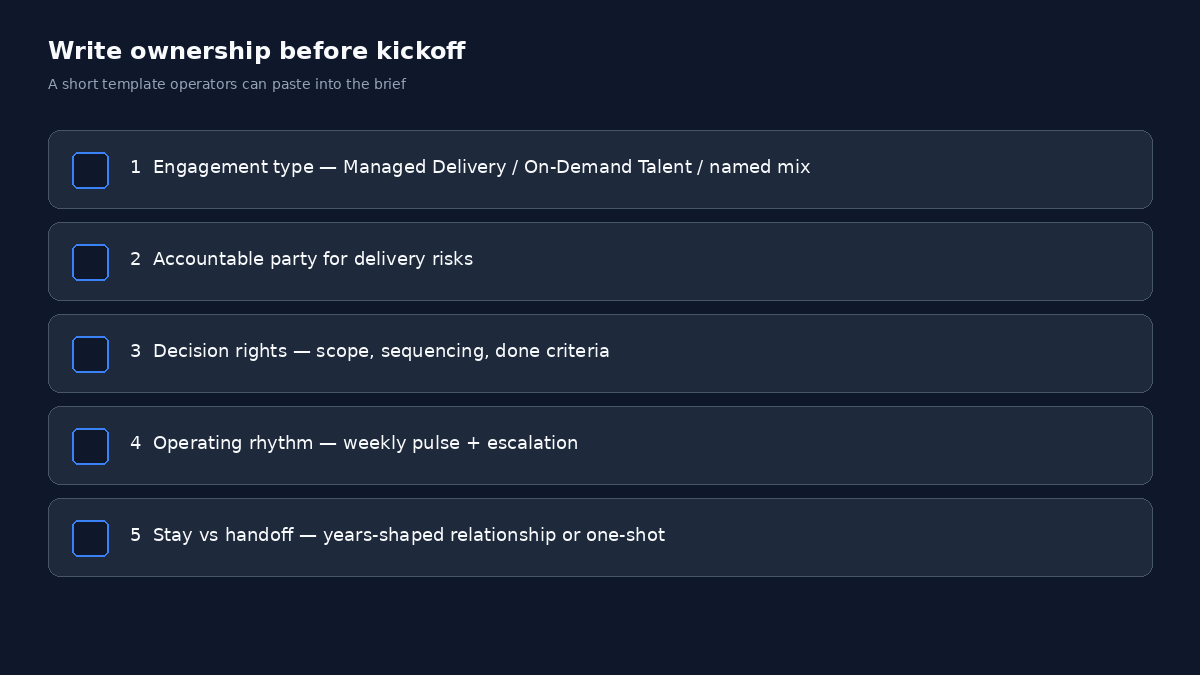
Use language a CFO or COO would not have to decode:
- Engagement type: Managed Delivery / On-Demand Talent / mix (name each stream).
- Accountable party for delivery risks: Partner delivery lead / Client manager / split by stream.
- Decision rights: Scope changes, sequencing, and “done” criteria—who approves.
- Operating rhythm: Weekly pulse owner, escalation path, and what gets shared asynchronously.
- Stay vs. handoff: Are you buying a years-shaped relationship or a one-shot project? Say it.
If any line is blank, you are not ready to kick off. You are ready for a clarifying call.
What this is not
- It is not public pricing or a rate card. Pricing belongs in a private conversation after the path and brief are clear.
- It is not “Top % talent” theater. Matching is about fit to your work, not a leaderboard claim.
- It is not four equal service lanes. JivePilot’s commercial surface is two engagements with clear ownership—not a menu of buzzwords.
- It is not a product checkout. When we mention AI systems we have built and operate (AwareCam, JiveAgents), that is build proof—evidence that delivery capacity includes real systems work—not a buy CTA from this article.
A practical decision tree for East Coast and Israel operators
Choose Managed Delivery when:
- You are tired of coordinating agencies, freelancers, and internal fragments for one outcome.
- Leadership bandwidth is the scarce resource—not just headcount.
- The work needs a single execution layer across marketing ops, product, or platforms.
Choose On-Demand Talent when:
- Your roadmap is already clear and managed in-house.
- You need scarce roles (engineering, product, marketing, operations, design, and similar) without a long recruiting cycle.
- You want people inside your tools, rituals, and accountability—not a black-box project.
Say “not sure” when:
- The problem is real but the ownership model is not.
- You might need both, sequenced.
- You want a founder-level conversation before you invent a SOW that fights itself.
That third path is not indecision. It is how serious buyers avoid buying the wrong thing politely.
Before you schedule the call
Bring one page, not a deck:
- What you are trying to ship in the next 90 days (one paragraph).
- Who on your side will manage priorities if talent embeds—or who will partner with a delivery lead if the outcome is managed.
- Constraints that matter: timezone overlap (East Coast / Israel is common for our ICP), stack, compliance, and what “local trust” means for your stakeholders.
We will ask which path and what you are shipping. Then you pick a time. Prefer async? Send a message with the same two fields; expect a reply within 24–48 hours.
Next step
Tell us which path you need — Managed Delivery, On-Demand Talent, or not sure yet.
Book a call — path picker + one line on what you’re shipping → calendar.
Related
- Why Scaling Operators Replace Five Vendors With One Delivery Lead
- Embedding Automation Engineers Without a Six-Month Recruiting Cycle
- How to Evaluate an Execution Partner Without Theater or Soft Stereotypes
Engagement structure lives on How we work · Work